Does Haze Affect Your Aircon? A Singapore Homeowner’s Guide
October 12, 2026
Quick Answer
Haze can increase airborne particulate pollution, and some particles that enter a home may collect on an aircon’s accessible filters. However, a standard split aircon is primarily for cooling, not a substitute for a properly sized air purifier. Check the filter condition, follow the manufacturer’s cleaning instructions, and arrange servicing if airflow or cooling remains poor.
Updated October 2026 · Aircon maintenance guide for Singapore homes
During a hazy period in Singapore, it is natural to close the windows and run the aircon more often. That keeps the room comfortable, but it also raises a practical question: does haze affect the aircon itself?
The main concern is airborne particles. Some may enter the home even when windows are closed, while indoor activities also produce dust. As room air circulates through an aircon, its filter can collect part of that dust load. The amount depends on the unit, filter type, room conditions and how often the system runs.
Can haze make an aircon filter dirty faster?
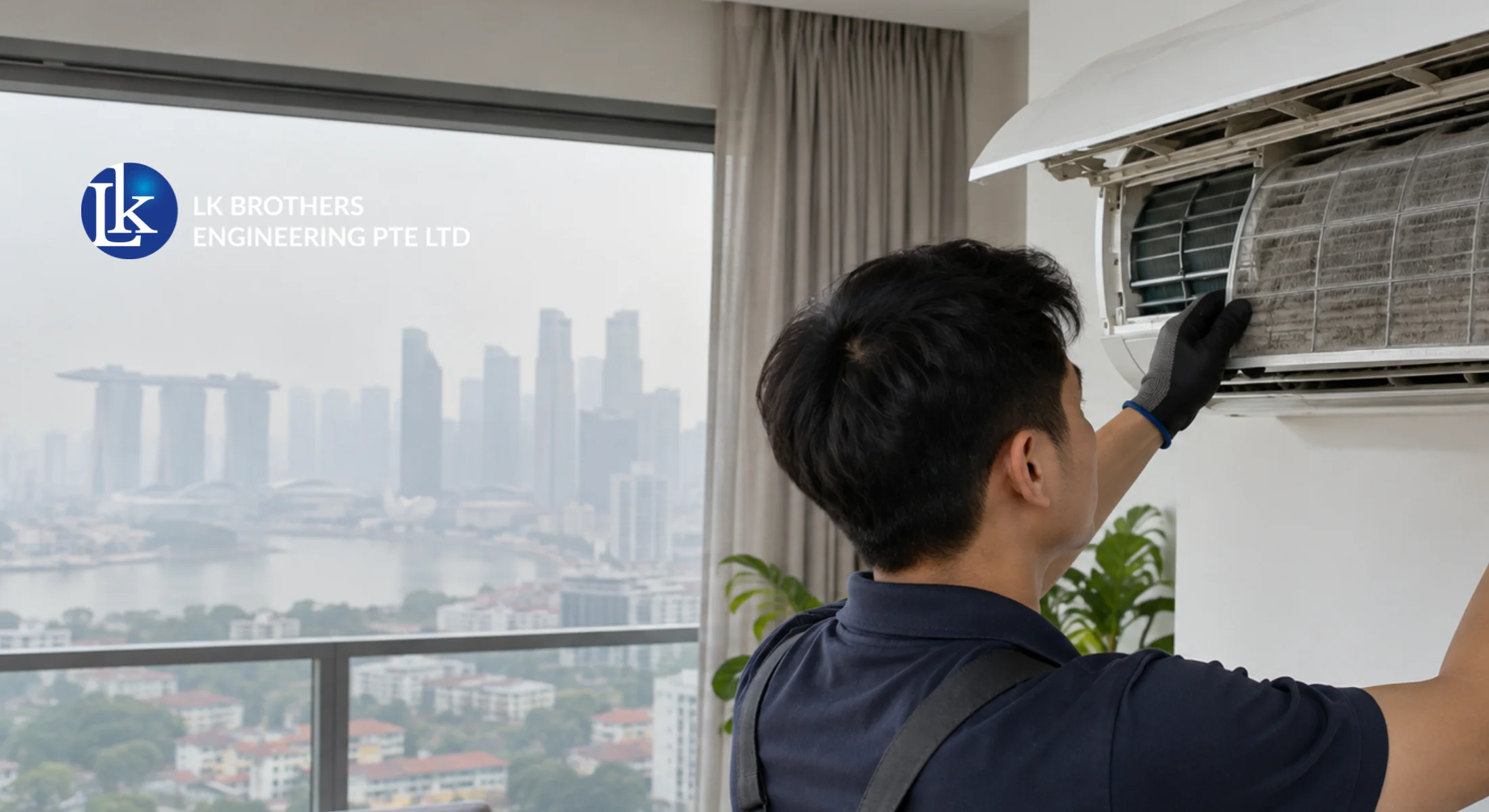
It can contribute to dirt on filters, but there is no fixed rule that every aircon needs professional servicing immediately after a haze episode. A filter that was already dusty, or a unit used for long hours, may need attention sooner than one that is relatively clean.
- Visible dust on the removable filter: check it and clean it as the manufacturer allows.
- Weaker airflow: a clogged filter is one possibility, but fan or coil issues can cause similar symptoms.
- Musty smell or water dripping: do not assume haze is the cause; these symptoms may have separate explanations.
- Cooling still feels weak after filter cleaning: consider a professional inspection instead of repeating DIY cleaning.
Wondering whether it is safe to switch on your aircon when the haze is especially bad? See our practical guide on using aircon during heavy haze in Singapore .
What should you do with your aircon during haze?
Singapore’s National Environment Agency (NEA) advises households to close doors and windows when outdoor air quality worsens, and reopen them once it improves. Air-conditioners can be used for cooling and air circulation. For window units that draw unfiltered outdoor air, NEA advises closing the outdoor air intake during haze.
| At home | What to do |
|---|---|
| Outdoor air looks hazy | Close windows and doors to reduce particle entry. |
| You need cooling | Use the aircon normally if it is in good working order. |
| You can access the removable filter safely | Inspect it and follow the brand’s instructions for cleaning and drying. |
| Air quality improves | Ventilate the home again when outdoor conditions allow. |
| You want better particle removal | Consider an appropriately sized portable air cleaner; check its CADR and room-size suitability. |
Source: NEA haze guidance for households and NEA guidance on portable air cleaners.
Does aircon remove haze particles or PM2.5?
A normal household split aircon is not designed to be your main PM2.5 protection. Its standard mesh pre-filter is intended largely to catch larger dust and debris, and filtration performance differs by system and filter. Do not assume a cooling unit performs like a HEPA air cleaner.
For particle control, a portable air cleaner with a suitable clean air delivery rate (CADR) can be helpful. For homes with central air-conditioning or mechanical ventilation, filtration choices are more technical and should be assessed against the system design.
For building systems, NEA also recommends maintaining air-conditioning and mechanical ventilation equipment and using appropriate filtration where feasible. See its indoor air quality guidance.
How to check an aircon filter safely
- Switch off the aircon before opening the front panel.
- Use the manufacturer’s guide for your exact model. Remove only the filter designed for user access.
- If washable, clean it using the method specified by the manufacturer and allow it to dry completely before reinstalling.
- Do not spray chemical cleaner into electrical components or dismantle internal parts.
- If airflow remains weak, do not force the unit to keep running; arrange an inspection.
Cleaning the removable mesh filter is different from cleaning the internal cooling coil, fan blower or drainage system. Those components may require a trained technician.
Do you need aircon servicing after haze?
Not automatically. Service based on the aircon’s condition, usage and maintenance schedule rather than the haze headline alone.
| What you notice | Reasonable next step |
|---|---|
| Filter looks dusty but cooling is normal | Clean the accessible filter as instructed; monitor performance. |
| Weak airflow or poor cooling continues | Book an aircon servicing assessment. |
| Water leakage, error code or unusual electrical smell | Stop using the unit if unsafe and request troubleshooting. |
| Someone recommends chemical wash just because of haze | Ask what internal contamination or operating problem makes it necessary. |
A chemical wash should be considered only when the condition of the system warrants deeper cleaning. Haze alone does not prove it is needed.
When filter cleaning is not enough
If a filter has been cleaned but the room still cools slowly, there may be contamination further inside the unit or a separate mechanical issue. A technician can assess the coil, blower, drain and operating condition, and explain whether routine servicing or troubleshooting makes more sense.
You can also read our aircon servicing checklist to understand what to prepare before a visit.
Frequently asked questions
Should I turn off my aircon during haze?
Not simply because it is hazy. NEA says air-conditioners may be used for cooling and circulation. For models with an unfiltered outdoor-air intake, follow NEA’s advice about closing the intake during haze.
Will haze damage my compressor?
Haze by itself does not establish compressor damage. If the unit shows abnormal noise, error codes or cooling problems, have the actual fault checked.
Is an aircon the same as an air purifier?
No. Standard split aircons primarily cool and circulate air. A suitable air cleaner is a more appropriate choice when the goal is reducing fine airborne particles.
Do I need chemical wash after a hazy week?
Not necessarily. Check the filter, airflow and actual condition first. Chemical cleaning is not a routine response to haze.
Keep your aircon working well through hazy periods
A straightforward approach works best: reduce outdoor particle entry when air quality worsens, maintain the accessible filter, and take persistent cooling or airflow problems seriously. There is no need to pay for unnecessary chemical work just because haze is in the news.
Aircon airflow or cooling not as good as before?
Let LK Brothers know what you are experiencing and when the unit was last serviced. We can help you arrange the appropriate servicing or fault assessment.
Arrange Aircon Servicing